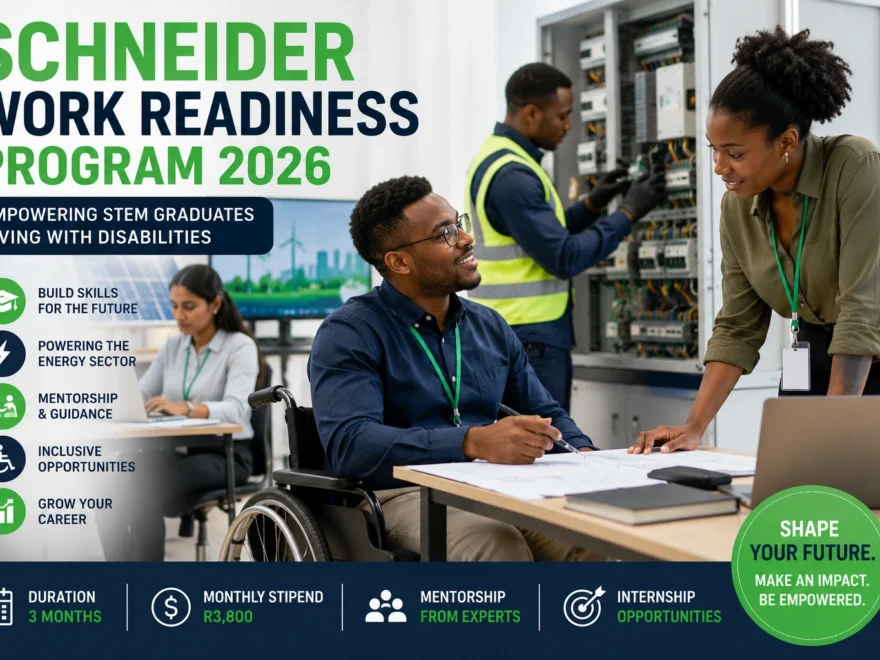
Discover the Schneider Work Readiness Program 2026, including requirements, R3,800 monthly stipend, benefits, eligibility, and how to apply.
South Africa continues to face the challenge of helping graduates transition successfully from higher education into meaningful employment. While many students complete qualifications in Science, Technology, Engineering, and Mathematics (STEM), employers often seek candidates with practical workplace experience, making it difficult for recent graduates to secure their first professional opportunity. For graduates living with disabilities, this transition can be even more challenging due to barriers related to accessibility, workplace inclusion, and limited industry exposure.
The Schneider Work Readiness Program 2026 has been designed to address some of these challenges by providing structured workplace readiness training for South African STEM graduates living with disabilities. Rather than functioning as a traditional internship, the programme focuses on preparing participants for employment within the electricity and energy sector through practical learning, mentorship, and professional development.
Over a three-month period, participants receive workplace exposure, industry insights, and guidance from experienced professionals while earning a monthly stipend. Outstanding performers may also be considered for internship opportunities after successfully completing the programme.
For graduates interested in engineering, renewable energy, environmental science, information technology, and related STEM disciplines, this programme represents an opportunity to strengthen employability while gaining valuable exposure to one of South Africa’s most important industries.
Quick Facts
| Information | Details |
|---|---|
| Programme | Schneider Work Readiness Program 2026 |
| Company | Schneider |
| Industry | Science & Technology |
| Location | Johannesburg, Gauteng, South Africa |
| Duration | 3 Months |
| Reference Number | Not stated in the official advert |
| Closing Date | Not stated in the official advert |
| Positions Available | Not stated in the official advert |
| Monthly Stipend | R3,800 per month |
| Required Gender | Not stated in the official advert |
Understanding the Schneider Work Readiness Program 2026
The Schneider Work Readiness Program 2026 has been developed specifically for South African STEM graduates living with disabilities who are preparing to enter the professional workforce.
Unlike permanent employment, the programme focuses on helping graduates bridge the gap between academic learning and workplace expectations. Through structured learning activities, mentorship, and practical industry exposure, participants gain a better understanding of the electricity and energy sector while developing professional competencies that employers value.
The programme also reflects a growing recognition that graduate employability depends not only on academic qualifications but also on workplace readiness, communication skills, and industry awareness.
Why Workplace Readiness Programmes Matter in South Africa
Many employers across the engineering, technology, and energy sectors report that graduates often possess strong theoretical knowledge but require additional workplace experience before they can confidently contribute to professional projects.
Work readiness programmes help close this gap by introducing participants to real organisational environments, professional expectations, and industry practices.
For graduates living with disabilities, initiatives like this also promote greater inclusion by creating structured opportunities to access mentorship, industry networks, and workplace experience.
The programme demonstrates the growing importance of diversity and inclusion within South Africa’s energy and technology sectors while supporting the development of future professionals.
What Makes This Programme Significant?
Several features distinguish the Schneider Work Readiness Program 2026 from many graduate development initiatives.
Firstly, the programme specifically targets graduates living with disabilities, demonstrating a commitment to expanding opportunities for underrepresented talent within STEM careers.
Secondly, participants receive a monthly stipend of R3,800, helping to reduce some of the financial pressures often experienced by unemployed graduates while they develop workplace skills.
The programme also focuses on practical industry exposure rather than classroom-based learning alone. Participants gain insight into electricity and energy operations while receiving mentorship from experienced professionals.
Perhaps most importantly, top-performing participants may be considered for internship placement after completing the programme, creating a potential pathway toward longer-term career development.
Who Should Consider Applying?
The programme is suitable for graduates who have recently completed qualifications in Science, Technology, Engineering, or Mathematics and are interested in careers within the electricity and energy sector.
Fields specifically mentioned include:
- Electrical Engineering
- Mechanical Engineering
- Civil Engineering
- Chemical Engineering
- Energy Studies
- Renewable Energy
- Physics
- Chemistry
- Mathematics
- Statistics
- Computer Science
- Information Technology
- Environmental Science
- Related STEM qualifications
Graduates who have minimal or no workplace experience are encouraged to apply if they meet the eligibility requirements.
REQUIREMENTS (MIN–MAX)
Minimum Requirements
Applicants must:
- Hold a Postgraduate qualification, Degree, or Diploma (NQF Level 5–8) in a STEM-related field.
- Be a South African citizen living with a disability.
- Be a recently graduated student or a final-year student with minimal or no work experience.
- Demonstrate a strong interest in the electricity and energy industry.
- Be committed to completing the full three-month programme.
Maximum Requirements
Not indicated in the official advert.
DUTIES
Although the advert describes a work readiness programme rather than permanent employment, successful participants will be expected to:
- Participate in structured workplace learning.
- Complete all programme activities during the three-month period.
- Engage with industry mentors.
- Develop workplace readiness skills.
- Gain exposure to real challenges within the electricity and energy sector.
- Build professional competencies.
- Demonstrate commitment throughout the programme.
- Participate actively in mentorship and learning opportunities.
Benefits of the Programme
Participants will receive:
- Three months of structured workplace readiness training.
- Monthly stipend of R3,800.
- Exposure to the electricity and energy industry.
- Guidance from experienced industry professionals.
- Professional mentorship.
- Practical workplace learning.
- Opportunity to strengthen employability.
- Potential consideration for internship placement upon successful completion.
ENQUIRIES
Not stated in the official advert.
CLOSING DATE
Not stated in the official advert.
Applicants are encouraged to apply as early as possible because application deadlines may be announced or vacancies may close without further notice.
SALARY
Not stated in the official advert.
Monthly Stipend: R3,800
COMPANY NAME
Schneider
NUMBER OF POSTS AVAILABLE
Not stated in the official advert.
HOW TO APPLY
Applications should be submitted through the official Schneider careers or recruitment platform where the Work Readiness Program 2026 vacancy is advertised.
Applicants should ensure that they prepare all requested supporting documentation before submitting their application.
Typical supporting documents may include:
- Updated Curriculum Vitae (CV).
- South African Identity Document.
- Qualification certificates or academic records.
- Proof of disability if requested during the application process.
- Any additional documents specified on the application platform.
Applicants should ensure that all information submitted is accurate and complete.
APPLY HERE: Schneider Work Readiness Program 2026
Final Thought
The Schneider Work Readiness Program 2026 represents an important opportunity for STEM graduates living with disabilities to gain practical workplace exposure within South Africa’s electricity and energy sector. By combining structured learning, professional mentorship, industry exposure, and a monthly stipend, the programme aims to strengthen graduate employability while promoting greater inclusion within technical professions. Although the advert does not specify the closing date, reference number, or number of available positions, eligible graduates who are committed to developing their careers in STEM should consider applying promptly.